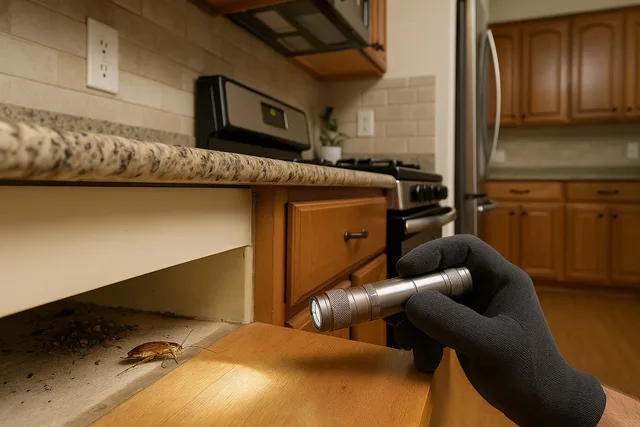
"Palmetto bug" is a Florida nickname for the large outdoor cockroaches that wander inside — mainly the American cockroach, sometimes the Florida woodroach or smokybrown. So a palmetto bug is a cockroach. The practical difference is these big outdoor roaches versus the small German cockroach that actually breeds in kitchens.
So What Is a Palmetto Bug, Exactly?
If you live in Cape Coral, Fort Myers, or anywhere in Southwest Florida, you have seen one. It is the big, reddish-brown roach that skitters across the lanai at night or turns up in the garage after a summer storm. People call it a palmetto bug because it is often found around palmettos, palm trees, and mulch beds. The name sounds nicer than "cockroach," but entomologically they are the same thing. "Palmetto bug" is just the Southern term for the large peridomestic cockroaches that live mostly outside.
American, Florida Woodroach, and Smokybrown: The Big Outdoor Roaches
The American cockroach is the one most people mean. It is the largest common roach in Florida, often an inch and a half or longer, reddish-brown with a pale figure-eight marking behind the head. It prefers warm, damp, dark places — sewers, storm drains, water meter boxes, mulch, and tree holes. It flies short distances in Florida's heat and is a strong climber, which is how it ends up on second-floor screens and in attics.
The Florida woodroach, or Florida woods cockroach, is darker, broader, and slower. It is sometimes called the "palmetto bug" too. It lives in leaf litter, under bark, and in palm boots, and when threatened it can release a foul-smelling fluid — earning it the nickname "stinking cockroach." It is clumsy and does not fly well, so it usually gets indoors by hitching a ride on firewood or through an open door.
The smokybrown cockroach is uniform mahogany-brown, a strong flier, and drawn to lights at night. It loves tree canopy, gutters full of leaves, and attics. In neighborhoods with mature oaks and palms, smokybrowns are often the roach thumping against your porch light or dropping onto the screen enclosure.
The Florida woodroach, or Florida woods cockroach, is darker, broader, and slower. It is sometimes called the "palmetto bug" too. It lives in leaf litter, under bark, and in palm boots, and when threatened it can release a foul-smelling fluid — earning it the nickname "stinking cockroach." It is clumsy and does not fly well, so it usually gets indoors by hitching a ride on firewood or through an open door.
The smokybrown cockroach is uniform mahogany-brown, a strong flier, and drawn to lights at night. It loves tree canopy, gutters full of leaves, and attics. In neighborhoods with mature oaks and palms, smokybrowns are often the roach thumping against your porch light or dropping onto the screen enclosure.
The German Cockroach Is a Different Problem Entirely
All three of those are outdoor roaches. They breed outside and come in by accident or to escape heat, drought, or heavy rain. That is the key distinction from the roach you actually do not want: the German cockroach.
The German cockroach is small — about half an inch — light brown, with two dark stripes behind the head. Unlike palmetto bugs, it does not live outdoors in Florida. It lives indoors, full stop, and it stays close to food and moisture: behind the refrigerator, under the sink, inside the dishwasher, in the seams of kitchen cabinets. One female and her offspring can produce thousands of roaches in a matter of months, and they hide in cracks you cannot reach with a can of spray. Seeing German cockroaches in daylight usually means the population is already large. This is a true infestation, and it needs targeted German roach treatment — baiting, growth regulators, and sanitation — not just a perimeter spray.
So the practical test is simple. Big reddish-brown roach on the patio, in the garage, or crossing the floor at night after rain? That is almost certainly a palmetto bug that wandered in from outside. Small striped roaches clustered in the kitchen or bathroom, active during the day? That points to a German cockroach infestation breeding indoors.
The German cockroach is small — about half an inch — light brown, with two dark stripes behind the head. Unlike palmetto bugs, it does not live outdoors in Florida. It lives indoors, full stop, and it stays close to food and moisture: behind the refrigerator, under the sink, inside the dishwasher, in the seams of kitchen cabinets. One female and her offspring can produce thousands of roaches in a matter of months, and they hide in cracks you cannot reach with a can of spray. Seeing German cockroaches in daylight usually means the population is already large. This is a true infestation, and it needs targeted German roach treatment — baiting, growth regulators, and sanitation — not just a perimeter spray.
So the practical test is simple. Big reddish-brown roach on the patio, in the garage, or crossing the floor at night after rain? That is almost certainly a palmetto bug that wandered in from outside. Small striped roaches clustered in the kitchen or bathroom, active during the day? That points to a German cockroach infestation breeding indoors.
Why Southwest Florida Homes See So Many
Southwest Florida is close to ideal habitat for palmetto bugs, and it comes down to heat, water, and vegetation. Our subtropical climate keeps them active year-round. Mulch beds, palm trees, and thick landscaping give them shelter and moisture right against the house. The canal system throughout Cape Coral and the low water table mean damp soil and standing water are never far away. Storm drains and sanitary sewers are effectively roach highways, and American cockroaches travel them freely, surfacing through drains and pipe penetrations. Add the daily summer rain from June through September, which floods their outdoor harborage and pushes them toward dry ground — your home — and you get the classic pattern of sightings spiking after a downpour.
Does One Palmetto Bug Mean an Infestation?
Usually not. Because these are outdoor insects, one or two sightings a week — especially at night, in the garage, or on the lanai after rain — is normal in this climate and typically means a few roaches are wandering in from the yard. That is a perimeter problem, not a breeding population inside your walls.
What should concern you is a different picture: multiple roaches every day, sightings in the daytime, egg cases in cabinets, or a musty odor. Consistent indoor activity — particularly small striped roaches in the kitchen — suggests something is reproducing inside and warrants an inspection.
What should concern you is a different picture: multiple roaches every day, sightings in the daytime, egg cases in cabinets, or a musty odor. Consistent indoor activity — particularly small striped roaches in the kitchen — suggests something is reproducing inside and warrants an inspection.
How to Keep Palmetto Bugs Out
Keeping palmetto bugs out is mostly about the exterior, because that is where they live. Pull mulch and dense plantings back a few inches from the foundation so there is a dry gap. Trim palm fronds and tree limbs away from the roof, since smokybrowns and Americans use them as bridges. Keep gutters clear, fix leaks and irrigation overspray, and move firewood and debris away from the walls. Seal the entry points they exploit: gaps around plumbing and A/C line penetrations, worn weather stripping under doors, torn screens, and unsealed vents. Cover or treat floor and sink drains, which are a favorite route for American cockroaches. A maintained exterior barrier treatment around the foundation stops most wanderers before they reach the door, which is why ongoing perimeter pest control is the most effective long-term control for palmetto bugs in this region.
Get the Right Treatment for the Right Roach
If palmetto bugs are getting past your defenses, or you suspect the small indoor kind, the fix is different for each and worth getting right the first time. Sun Pest Control handles both across Cape Coral pest control and Fort Myers pest control routes — knocking down the outdoor population and sealing the perimeter for palmetto bugs, and running a full baiting and monitoring program for German cockroaches indoors.
Frequently Asked Questions
Keep reading

Reviewed by Sun Pest Control — FL Pest Control License #JB341709, family-owned since 2011.